
Hair Loss – What Causes It and What Can Be Done?

That moment when you start noticing too many hairs on your brush, in the sink after a shower, or on your pillow in the morning can be stressful and worrying. For both men and women, full, healthy hair is often an inseparable part of one’s identity and self-confidence. Therefore, hair loss is not just an aesthetic issue; it can signal internal changes in the body and significantly affect emotional well-being.
Starting from the Root of the Problem
If you’re concerned about hair loss—whether you’re a man noticing a receding hairline or a woman realizing your ponytail is thinning—it’s important to understand that you’re not alone. Hair loss is extremely common, and more importantly, modern science understands it deeply. In many cases, with proper diagnosis and early treatment, it is possible to slow down, stop, or even reverse the process—especially when choosing a personalized treatment instead of trying to fit yourself into a generic one. Before selecting the right treatment, it’s important to understand the real causes behind hair loss.
What is natural hair shedding Vs hair loss (baldness)?
Natural Hair Shedding – Every hair on your head goes through a regular life cycle. The first and longest stage is the growth phase (anagen), which can last between two and seven years. It is followed by a short transition phase (catagen), and finally, a resting phase (telogen) lasting about three months, after which the hair naturally falls out to make room for a new one growing from the same follicle. Losing 50–100 hairs a day is completely normal. Recent studies (2024) show that shedding up to 150 hairs a day is still considered normal for people with long or especially thick hair.
Baldness – When this natural balance is disrupted, or when too many hairs enter the resting phase at once, baldness may occur. The hair follicles themselves shrink and degenerate in a process known as miniaturization, producing thinner, finer, and shorter hairs until they eventually stop producing hair altogether. It’s important to note that baldness can sometimes be temporary, depending on the cause.
The Main Cause of Hair Loss: Androgenetic Alopecia (Genetics and Hormones)
This is the most common cause of hair loss worldwide, affecting both men and women. Contrary to the myth, it’s not passed only from your maternal grandfather—it’s a complex hereditary tendency that can come from both sides of the family.
At the core of this condition lies a heightened sensitivity of hair follicles to a specific androgen hormone, a byproduct of testosterone. This hormone—also present in small amounts in women—binds to sensitive follicles, causing them to shrink (miniaturize). Their growth phase shortens, and they produce weaker and thinner hair with each cycle until they eventually stop growing hair.
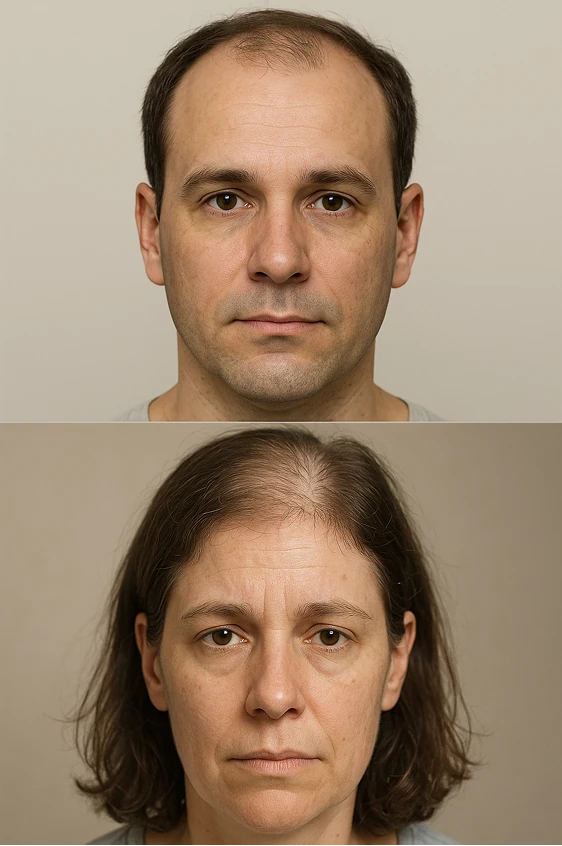
In men (Male Pattern Baldness):The process usually starts with a receding hairline at the temples and continues with thinning at the crown.
In women (Female Pattern Hair Loss):The pattern is different; the frontal hairline is often preserved, but the top of the scalp becomes thinner. The first visible sign is usually a widening of the central hair part.
Autoimmune Cause: Alopecia Areata
This is a completely different condition in which the immune system mistakenly attacks hair follicles, identifying them as foreign invaders. It typically appears as smooth, round bald patches on the scalp, beard, or body. The severity can range from mild (one or two spots) to more severe cases, and in rare situations, it may lead to total hair loss.
Solutions for Stimulating Hair Growth
Improving Blood Flow to the Scalp
This is the most common external treatment, available as a lotion or foam applied directly to the scalp. It works by dilating blood vessels around the hair follicles, improving blood flow, oxygen, and nutrient supply, thereby prolonging the growth phase and helping dormant follicles reawaken.
Advantages: Available without prescription, easy for daily use, suitable for both men and women, minimal local side effects.
Disadvantages: Requires continuous use to maintain results, may cause scalp irritation, results vary from person to person.
Oral Medication
Recommended for men suffering from androgenetic alopecia. It is a once-daily pill prescribed by a doctor that directly addresses the hormonal cause—it inhibits the enzyme 5-alpha reductase, which converts testosterone into its damaging derivative DHT. By dramatically reducing DHT levels in the scalp, the treatment halts follicle miniaturization, often stopping hair loss, thickening existing hair, and even promoting regrowth.
Advantages: Convenient (one pill per day), acts across the entire scalp.
Disadvantages: Requires a prescription, may cause rare sexual side effects, not suitable for women of childbearing age, must be used continuously.
PRP (Platelet-Rich Plasma) Therapy
A popular biological treatment that uses the body’s own healing mechanisms. A small blood sample is taken from the patient and spun in a centrifuge to isolate the plasma rich in platelets (which contain growth factors). This concentrated plasma is then injected into thinning scalp areas. The growth factors signal dormant follicles to activate, reduce inflammation, and encourage new growth.
Advantages: Natural (uses the patient’s own blood), no rejection risk, reduces inflammation, visible results within months.
Disadvantages: Expensive, requires several sessions (3–6), involves injections (mild pain), results vary and are not guaranteed.
Low-Level Laser Therapy (LLLT)
This treatment uses low-level red or infrared light energy. The theory is that the light is absorbed by follicle cells and stimulates mitochondria (the cell’s power plants) to produce more energy (ATP). This added energy prolongs the growth phase, reduces inflammation, and strengthens follicles. Available in clinics or as home-use devices.
Advantages: Non-invasive, painless, suitable for home use.
Disadvantages: Slow results (3–6 months), requires consistent use (2–3 times per week), scientific evidence remains mixed, high initial cost for home devices.
Hair Transplant
When areas of baldness have no living follicles left, no topical or oral treatment can regrow hair there. In such cases, the solution is surgical. A hair transplant doesn’t create new hair but rather relocates existing hair. The surgeon extracts healthy, genetically resistant follicles (usually from the back of the scalp) and transplants them one by one to thinning or bald areas.
Advantages: Permanent and natural-looking results, definitive solution for bald spots, transplanted hair does not fall out.
Disadvantages:Expensive surgery, involves recovery and discomfort, risk of scarring or infection, limited by available donor hair.
Wigs (Natural or Synthetic)
A non-surgical, non-medical solution that provides immediate coverage for thinning or bald areas. Wigs are attached using clips, adhesives, or special nets. They can be made of human hair or synthetic fibers and come in various styles, colors, and lengths. Suitable for anyone wanting a full, natural look without waiting for hair to grow.
Advantages: Instant results, painless, no medical risk, easy style changes, suitable for both men and women.
Disadvantages: Does not treat the underlying cause, requires daily maintenance, may be uncomfortable in heat, high-quality wigs are costly.
Personalized Hair Loss Treatment with SKCURE
At SKCURE, we redefine the approach to hair loss treatment — shifting from generic solutions to advanced personalized compounding, with a preference for local treatments over systemic ones. We understand that your hair loss is unique; that’s why instead of purchasing multiple products, our team of expert physicians formulates a customized therapeutic formula specifically for you. This formula combines several active ingredients in precise concentrations tailored to your condition, working in synergy for maximum results. This approach makes treatment simpler and more convenient. The process begins with an innovative AI-powered initial assessment, followed by a comprehensive online medical questionnaire that is analyzed directly by our doctors to create a truly personalized solution — all without leaving your home, with discreet delivery straight to your door.

Authored By - Dr. Shlomo Sadoun
A pioneering pharma entrepreneur with over two decades of experience in the health and biotechnology sectors. Operating at the intersection of science, innovation, and a global vision, leading the development of advanced medical solutions with a real impact on patients’ lives.